Participate, Involvement, Inclusion: ALIGNMENT
Alignment is often talked about as if it were a chair sitting in the corner of the room. Something static. Something you point to. In our research we found that Alignment is not an object and not a slogan. Alignment is a process. Just as homeostasis keeps the human body in physiological balance, Alignment keeps our neurological and psychological self in balance. When we are in balance, we feel good. When we are out of balance we do not.
Neurologically, Alignment occurs when THINK, FEEL and ACT are working in balance. All three operating in synch. Our work at Winning Profile developed a behavioral process for producing that Alignment. When people, athletes, coworkers, parents or management gain Alignment, performance increases because behavior becomes internally powered and consistent.
Three Stages of Engagement
Participate. Not everyone chooses to participate, wants to participate or knows how to participate. Your Winning Profile will show why this is. It allows people to relax if they do not want to participate and not feel guilty or apologetic. Others will participate easily and love it.
Involvement. Some feel comfortable observing. Some reflect. Some think. Some jump in. True involvement will never take place until all four forms are accepted as equally valid. Acceptance comes from understanding that everyone involves themselves differently.
Inclusion. True inclusion is an outcome. It takes participation, involvement and a belief that forms when people can THINK a process is beneficial, FEEL an emotional buy in and ACT by seeing outcomes they themselves created. Inclusion cannot be imposed. It must be experienced.
If you were to observe our Leadership Development Alignment methods, you might think you were watching simple group work. You are not. Our process uses Huddles of four people. There is a significant difference between group work and Huddles. Group work can be small or as large as you can imagine. In larger groups someone is ‘telling’ or sending a message. In these situations, the numbers in the session will all leave what they ‘think’ they heard. Huddles are designed to capture all three steps neurologically and create equal cognitive and emotional assimilation. Research shows that humans work best in groups of four when trying to integrate thinking, feeling and understanding. This is why Huddles matter.
FOCUS MODEL – A model for Inclusion
FOCUS is a four step process that activates Alignment. It moves left to right and allows people to create their own Picture, Perception, Attitude and Value before they adopt a new action.
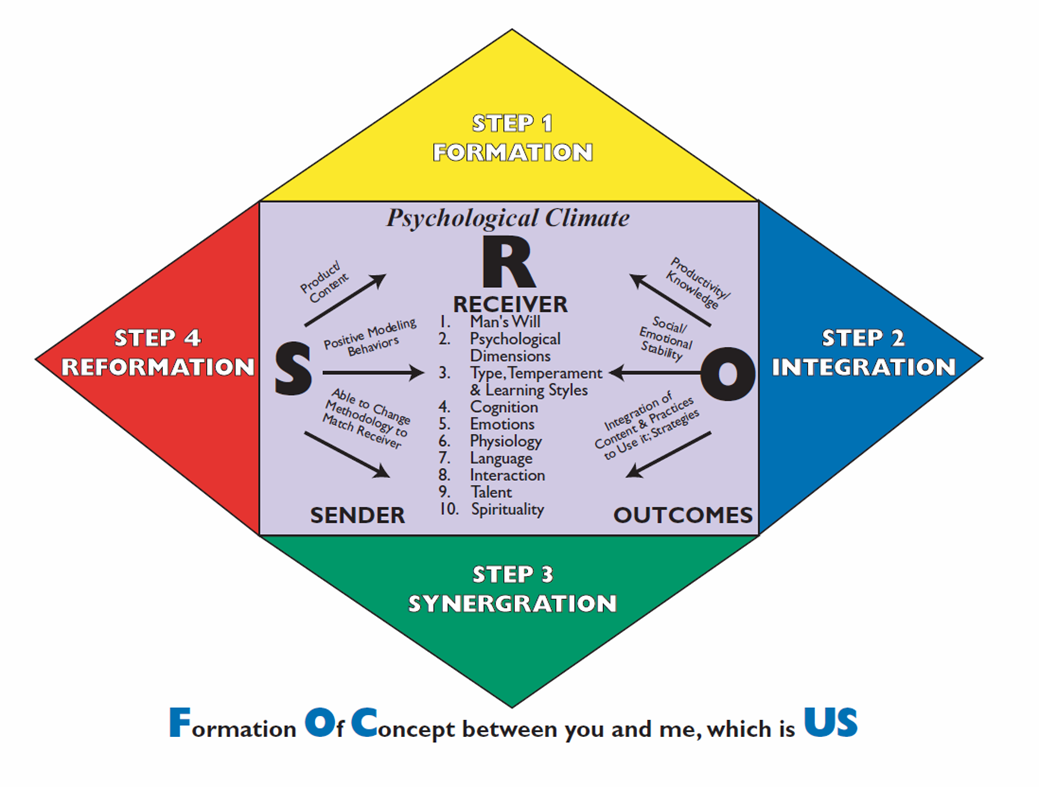
An infographic of the S-R-O concept of the FOCUS model
STEP 1 - Formation of concept
Each person is asked the same question. We assume everyone will give the same answer. They do not. Each person develops their own picture and believes it is shared. It is not. This is why individual starting points matter.
Step 2 - Integration of Concept
Differences are necessary. Participants begin in pairs by sharing pictures, from their brain and identifying commonalities and differences shared. Two answers are charted into one. Then two pairs integrate into one chart of four. If six Huddles each work with four people you begin with 24 answers and end with six charts on the wall. A team member stands by each chart, listening and marking similarities as the room cycles through the material. The group sees commonalities and differences clearly.
Step 3 - Synergration of Concept
One person from each Huddle meets with the other Huddle leaders. They reduce six charts into one aligned plan representing everyone. Synergration creates the output that is greater than the sum of the parts. People begin to trust the process because they see their input in the aligned outcome. This is the true beginning of Activation.
Step 4 - Reformation of Concept
This is the review stage through S.O.C.T. analysis. Strengths and Opportunities always come first. These two steps begin to build a culture of strength. Challenges and Threats then cycle back to Step 1. The process becomes continuous improvement fueled by internal buy in, not external pushing.
Across fields such as leadership, business, coaching, education, public service and team development, exposure to the FOCUS Model consistently increases internal efficacy and reduces burnout because it builds a relaxed, receiver oriented environment that matches diverse learning styles. People feel belonging and acceptance. These conditions strengthen performance because Alignment strengthens internal energy.
Why Inclusion Fails Without Clarity
Group work often collapses because people begin to assume that every discussion equals shared authority. It does not. True inclusion requires a higher level of interaction and communication. Understanding levels of authority and responsibility requires a higher level of inclusion. We teach six Levels of Decisions to show what is actually being asked of people in a participatory process.
LEVELS OF DECISIONS - Kinds of Decisions Made from our Levels of AUTHORITY and Responsibility
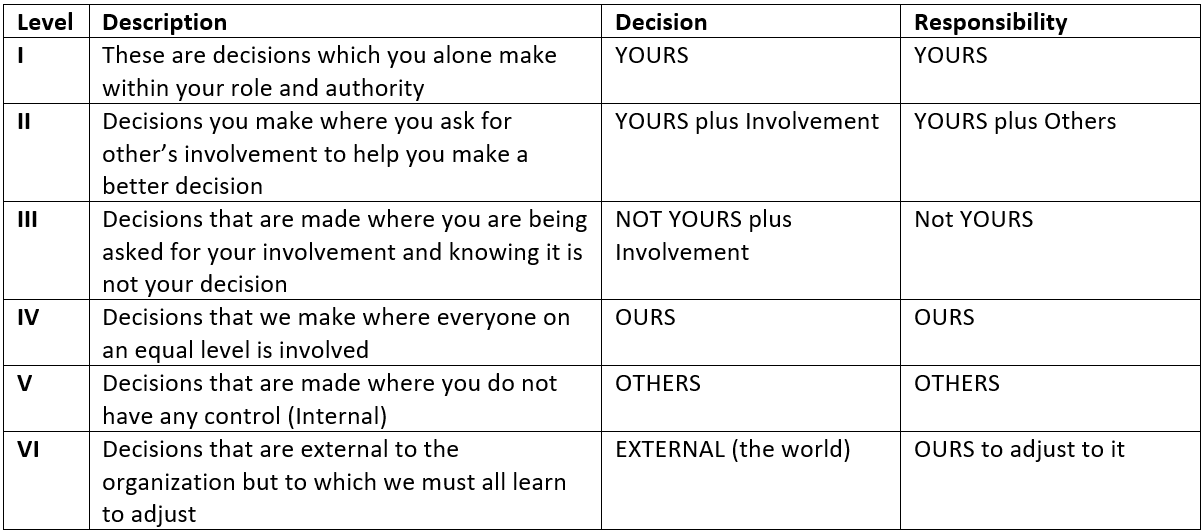
Levels of decisions table
If you want an organization or team to develop alignment, raise performance and create measurable improvements, the process must be participatory, neurological and psychologically grounded. Alignment is not a slogan but a process. A process that works!